Tuesday, November 27, 2012
"Pop music and poetry are the conversations I have with myself, the Baedekers with which I navigate crucial experiences."
This quote summarizes my life.
Let's revive this blog, shall we?
Of pop & poetry
I read this article today instead of doing my actual homework. But I am posting it on here because I want to save it for future reference (future meaning Christmas break, when I intend to write a masterpiece of a paper subtitled something like "Echoes of Wordsworth in Pink Floyd's The Wall." I told you about that, right? I am so excited.)

Tuesday, July 24, 2012
Happy Pioneer Day!
In celebration of this festive occasion, I am going to pull a grandpa move on you. And by that, I mean my grandpa. And by that, I mean I'm going to tell you a story about Karl G, my famed pioneer ancestor.
Here is an account he wrote himself, published in the 1889 Improvement Era. It's a pretty cool story by itself, but I find it especially significant to us because your pioneer ancestor Mr. Budge makes a notable appearance! (Tell your dad!) It just melts my heart to think of the deep spiritual relationship that our forbears shared with one another. If they could only see the truest of true friendships that their progenitors have built today, I am sure they would be proud.

Karl G. Maeser
Only in compliance with the counsel of President F. D. Richards have I reluctantly yielded to the repeated solicitations of the editor to relate briefly in the columns of the Era the incidents preceding and accompanying my conversion to the great work of the latter days, and my baptism into The Church, at Dresden, Saxony, October 14, 1855.
As "Oberlehrer" at the Budich Institute, Neustadt, Dresden, I, like most of my fellow-teachers in Germany, had become imbued with the scepticism that characterizes to a large extent the tendency of modern higher education, but I was realizing at the same time the unsatisfactory condition of a mind that has nothing to rely on but the ever changing propositions of speculative philosophy.
Although filled with admiration of the indomitable courage, sincere devotion, and indefatigable energy of the great German Reformer, Martin Luther, I could not fail to see that his work had been merely all initiatory one, and that the various protestant sects, taking their initiative from the revolutionary stand of the heroic monk at Wittenberg and Worms, had entirely failed to comprehend the mission of the reformation. The only strength of Protestantism seemed to be its negative position to the Catholic church; while in most of the positive doctrines of the multifarious protestant sects their antagonism to one another culminated only too often in uncompromising zealotry. These ideas illustrate in the main my views on religious subjects, at that time, and are explanatory of the fact that scepticism had undermined the religious impressions of my childhood days, and why infidelity, now known by its modern name as agnosticism, was exercising its disintegrating influence upon me.
In that dark period of my life, when I was searching for a foothold among the political, social, philosophical, and religious opinions of the world, my attention was called to a pamphlet on the "Mormons," written by a man named Busch. The author wrote in a spirit of opposition to that strange people, but his very illogical deductions and sarcastic invectives aroused my curiosity, and an irresistible desire to know more about the subject of the author's animadversion caused me to make persistent inquiries concerning it. There were no "Mormons" in Saxony at that time, but, as I accidentally found in an illustrated paper, they had a mission in Denmark. Through an agent, I obtained the address of Elder Van Colt, then President of the Scandinavian mission. My letter addressed to that gentleman brought the answer that neither he nor his secretary could understand much German, but that Elder Daniel Tyler, President of the Swiss and German mission at Geneva, would give me all information I should desire on the subject of "Mormonism." I addressed myself, therefore, to that gentleman.
What I now relate in this paragraph, I never learned until twelve years later, at Beaver City, Utah, where Brother Tyler related it in my presence, at a meeting of the Relief Society. When my letter arrived at Geneva, headquarters of the mission, one of the traveling Elders suggested to President Tyler to have nothing to do with the writer of the letter, but to send it back without any answer, as it was most likely only a trick of the German police to catch our possible connections in that country. President Tyler declared that as the letter was impressing him quite differently, he would send it back as suggested, but that it would come back again with more added to it, if the Lord was with the writer. Thus I got my letter back without any explanation or signature, only in a new envelope addressed to me. I felt insulted, and sent it with a few words of inquiries about this strange procedure, to Elder Van Cott, at Copenhagen. By return mail I received an apology from President Van Cott, stating that there must be a mistake somewhere, as Elder Tyler was a good and wise man. He had, however, sent my letter again to Geneva with an endorsement. This led to a long correspondence between Elder Tyler and myself. Pamphlets and some books were forwarded to me. Having some conceited notions in those days about illiteracy, and no faith in Bible or religious doctrines, correspondence and publications had no other effect upon me than to convince me that "Mormonism" was a much bigger thing than I had anticipated. I therefore expressed a desire for having an Elder sent to me.
A few weeks after that request had been made, Elder William Budge, now President of Bear Lake Stake, arrived at my house. It was providential that such a man was the first "Mormon" I ever beheld, for, although scarcely able to make himself understood in German, he, by his winning and yet dignified personality, created an impression upon me and my family which was the keynote to an indispensable influence that hallowed the principles he advocated. After about eight weeks' sojourn in our family, during which time my brother-in-law, Brother Edward Schoenfeld, and wife, and another teacher at one of the public schools in Dresden, had become interested in the teachings of the "Mormon" Elder, Elder F. D. Richards, then President of the European mission, and Elder William Kimball, arrived in Dresden. A few interviews at which Elder Budge acted as interpreter, led to the baptism of eight souls in the river Elbe; the first baptisms after the order of the Church of Jesus Christ of Latter-day Saints in that country.
On coming out of the water, I lifted both of my hands to heaven and said: "Father, if what I have done just now is pleasing unto thee, give me a testimony, and whatever thou shouldst require of my hands I shall do, even to the laying down of my life for this cause."
There seethed to be no response to my fervent appeal, and we walked home together, President Richards and Elder Budge at the right and the left of me, while the other three men walked some distance behind us, so as to attract no notice. The other members of the family were baptized a few days later. Our conversation was on the subject of the authority of the Priesthood, Elder Budge acting as interpreter. Suddenly I stopped Elder Budge from interpreting President Richards' remarks, as I understood them, and replied in German, when again the interpretation was not needed as President Richards understood me also. Thus we kept on conversing until we arrived at the point of separation, when the manifestation as suddenly ceased as it had come. It did not appear to me as strange at all while it lasted, but as soon as it stopped, I asked Brother Budge what that all meant, and received the answer that God had given me a testimony. For some time afterwards, whenever I conversed with President Richards, in England, we could understand each other more readily than when I was conversing with others, or rather trying to converse, until my progress in the English language made this capacity unnecessary.
This is the plain statement of the power of the Holy Spirit manifested to me by the mercy of my Heavenly Father, the first one of the many that have followed, and that have corroborated the sincere conviction of my soul, that the Church of Jesus Christ of Latter-day Saints is of God and not of man.
*Karl G. Maeser (1828-1901), one of Mormondom's most beloved educators, was born in Meiszen, Saxony, Germany. Well educated, Dr. Maeser became a successful German educator. He was baptized into the Church in 1855, after which he resigned his position and moved with his family to London, where he labored among German-speaking residents, building up a branch of the Church. In 1856, he emigrated to Philadelphia, where he labored for the Church until 1860, then moved to Utah and began teaching school. In 1864 he was called to become tutor to Brigham Young's family. Later, in 1867, while he was serving as an organist for the Tabernacle Choir, he was called to preside over the Swiss and German mission, where he founded the Church journal, Der Stern. In 1876 Brigham Young called Dr. Maeser to establish the Brigham Young Academy in Provo, Utah (later BYU), where he worked until his death, a leader in the Church Sunday School system and in the higher education program of the Church. This account of his conversion was published in the 1889 Improvement Era.
from http://mldb.byu.edu/kgmaeser.htm
Here is an account he wrote himself, published in the 1889 Improvement Era. It's a pretty cool story by itself, but I find it especially significant to us because your pioneer ancestor Mr. Budge makes a notable appearance! (Tell your dad!) It just melts my heart to think of the deep spiritual relationship that our forbears shared with one another. If they could only see the truest of true friendships that their progenitors have built today, I am sure they would be proud.
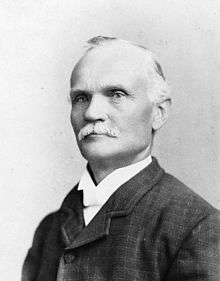 |
| There's a handsome guy. |
Mormon Literature Sampler:
How I Became a "Mormon"
Only in compliance with the counsel of President F. D. Richards have I reluctantly yielded to the repeated solicitations of the editor to relate briefly in the columns of the Era the incidents preceding and accompanying my conversion to the great work of the latter days, and my baptism into The Church, at Dresden, Saxony, October 14, 1855.
As "Oberlehrer" at the Budich Institute, Neustadt, Dresden, I, like most of my fellow-teachers in Germany, had become imbued with the scepticism that characterizes to a large extent the tendency of modern higher education, but I was realizing at the same time the unsatisfactory condition of a mind that has nothing to rely on but the ever changing propositions of speculative philosophy.
Although filled with admiration of the indomitable courage, sincere devotion, and indefatigable energy of the great German Reformer, Martin Luther, I could not fail to see that his work had been merely all initiatory one, and that the various protestant sects, taking their initiative from the revolutionary stand of the heroic monk at Wittenberg and Worms, had entirely failed to comprehend the mission of the reformation. The only strength of Protestantism seemed to be its negative position to the Catholic church; while in most of the positive doctrines of the multifarious protestant sects their antagonism to one another culminated only too often in uncompromising zealotry. These ideas illustrate in the main my views on religious subjects, at that time, and are explanatory of the fact that scepticism had undermined the religious impressions of my childhood days, and why infidelity, now known by its modern name as agnosticism, was exercising its disintegrating influence upon me.
In that dark period of my life, when I was searching for a foothold among the political, social, philosophical, and religious opinions of the world, my attention was called to a pamphlet on the "Mormons," written by a man named Busch. The author wrote in a spirit of opposition to that strange people, but his very illogical deductions and sarcastic invectives aroused my curiosity, and an irresistible desire to know more about the subject of the author's animadversion caused me to make persistent inquiries concerning it. There were no "Mormons" in Saxony at that time, but, as I accidentally found in an illustrated paper, they had a mission in Denmark. Through an agent, I obtained the address of Elder Van Colt, then President of the Scandinavian mission. My letter addressed to that gentleman brought the answer that neither he nor his secretary could understand much German, but that Elder Daniel Tyler, President of the Swiss and German mission at Geneva, would give me all information I should desire on the subject of "Mormonism." I addressed myself, therefore, to that gentleman.
What I now relate in this paragraph, I never learned until twelve years later, at Beaver City, Utah, where Brother Tyler related it in my presence, at a meeting of the Relief Society. When my letter arrived at Geneva, headquarters of the mission, one of the traveling Elders suggested to President Tyler to have nothing to do with the writer of the letter, but to send it back without any answer, as it was most likely only a trick of the German police to catch our possible connections in that country. President Tyler declared that as the letter was impressing him quite differently, he would send it back as suggested, but that it would come back again with more added to it, if the Lord was with the writer. Thus I got my letter back without any explanation or signature, only in a new envelope addressed to me. I felt insulted, and sent it with a few words of inquiries about this strange procedure, to Elder Van Cott, at Copenhagen. By return mail I received an apology from President Van Cott, stating that there must be a mistake somewhere, as Elder Tyler was a good and wise man. He had, however, sent my letter again to Geneva with an endorsement. This led to a long correspondence between Elder Tyler and myself. Pamphlets and some books were forwarded to me. Having some conceited notions in those days about illiteracy, and no faith in Bible or religious doctrines, correspondence and publications had no other effect upon me than to convince me that "Mormonism" was a much bigger thing than I had anticipated. I therefore expressed a desire for having an Elder sent to me.
A few weeks after that request had been made, Elder William Budge, now President of Bear Lake Stake, arrived at my house. It was providential that such a man was the first "Mormon" I ever beheld, for, although scarcely able to make himself understood in German, he, by his winning and yet dignified personality, created an impression upon me and my family which was the keynote to an indispensable influence that hallowed the principles he advocated. After about eight weeks' sojourn in our family, during which time my brother-in-law, Brother Edward Schoenfeld, and wife, and another teacher at one of the public schools in Dresden, had become interested in the teachings of the "Mormon" Elder, Elder F. D. Richards, then President of the European mission, and Elder William Kimball, arrived in Dresden. A few interviews at which Elder Budge acted as interpreter, led to the baptism of eight souls in the river Elbe; the first baptisms after the order of the Church of Jesus Christ of Latter-day Saints in that country.
On coming out of the water, I lifted both of my hands to heaven and said: "Father, if what I have done just now is pleasing unto thee, give me a testimony, and whatever thou shouldst require of my hands I shall do, even to the laying down of my life for this cause."
There seethed to be no response to my fervent appeal, and we walked home together, President Richards and Elder Budge at the right and the left of me, while the other three men walked some distance behind us, so as to attract no notice. The other members of the family were baptized a few days later. Our conversation was on the subject of the authority of the Priesthood, Elder Budge acting as interpreter. Suddenly I stopped Elder Budge from interpreting President Richards' remarks, as I understood them, and replied in German, when again the interpretation was not needed as President Richards understood me also. Thus we kept on conversing until we arrived at the point of separation, when the manifestation as suddenly ceased as it had come. It did not appear to me as strange at all while it lasted, but as soon as it stopped, I asked Brother Budge what that all meant, and received the answer that God had given me a testimony. For some time afterwards, whenever I conversed with President Richards, in England, we could understand each other more readily than when I was conversing with others, or rather trying to converse, until my progress in the English language made this capacity unnecessary.
This is the plain statement of the power of the Holy Spirit manifested to me by the mercy of my Heavenly Father, the first one of the many that have followed, and that have corroborated the sincere conviction of my soul, that the Church of Jesus Christ of Latter-day Saints is of God and not of man.
*Karl G. Maeser (1828-1901), one of Mormondom's most beloved educators, was born in Meiszen, Saxony, Germany. Well educated, Dr. Maeser became a successful German educator. He was baptized into the Church in 1855, after which he resigned his position and moved with his family to London, where he labored among German-speaking residents, building up a branch of the Church. In 1856, he emigrated to Philadelphia, where he labored for the Church until 1860, then moved to Utah and began teaching school. In 1864 he was called to become tutor to Brigham Young's family. Later, in 1867, while he was serving as an organist for the Tabernacle Choir, he was called to preside over the Swiss and German mission, where he founded the Church journal, Der Stern. In 1876 Brigham Young called Dr. Maeser to establish the Brigham Young Academy in Provo, Utah (later BYU), where he worked until his death, a leader in the Church Sunday School system and in the higher education program of the Church. This account of his conversion was published in the 1889 Improvement Era.
from http://mldb.byu.edu/kgmaeser.htm
Thursday, July 19, 2012
Stories
So, there is a little thing I have been doing these past weeks that I neglected to tell you about. I don't really know why I didn't mention it, but I think it will be easier to explain in blog post format so it's OK. I been writing some short stories! Because, I just realized, what I really want to do is be a writer and that's not one of those things in which you graduate with a degree and then apply for jobs and work your way up; if you want to do it, you just do it. And I figure, this is my last little snippet of free time before school starts, and then I may be off on a mission, and then who knows, so I've just been churning 'em out and hoping they're good. I've finished two and three quarters short stories (meaning one full story and three quarters of one and half of two others). I am pretty proud of myself.
The thing is, though, I feel like I have no idea what makes a good story. I mean, I've been reading a lot of them lately for practice--ones that are famous and ones that have been recently published in prominent magazines & journals, etc. And I know what I like and what I don't like. But it's sort of difficult to tell whether my own stories are hitting the mark or not. I rented a textbook from the library called, Behind the Short Story: From First to Final Draft, which has been rather helpful. What I mainly wanted to do in this post was to share with you a few inspirational quotes on writing I've gathered from this book, as well as from other sources.
"I can't explain inspiration. A writer is either compelled to write or not. And if I waited for inspiration I wouldn't really be a writer." -Toni Morrison
". . . I don't believe much in style. In fact, most young writers screw themselves royally when they make a conscious effort at style. They overdo the metaphors and adverbs and clever phrases. They call attention to themselves, relentlessly, rather than to the fictional world they're trying to create. I'm not suggesting that writers should ignore the beauty and elegance of the language. But I am suggesting that such beauty and elegance must emerge organically from an effort to tell the truth. Style is a function of the truth. It is not some free-floating gloss you can dump on your work to make it shine. If you force your characters to face their darkest truths, the language of the story will naturally rise into the lyric register. It will have to do so, in order to express the depth of their feelings." -Steve Almond
"I want stories to startle and engage me within the first few sentences, and in the middle to widen or deepen or sharpen my knowledge of human activity, and to end by giving me a sensation of a completed statement." -John Updike
"The fiction writer has to realize that he can't create compassion with compassion, or emotion with emotion, or thought with thought. He has to provide all these things with a body; he has to create a world with weight and extension." -Flannery O'Connor
Also, there is a pretty cool thing I have learned already about writing. While it is easiest to come up with stories based on my own experience, I feel like those stories often end up boring and go nowhere. When I write a main character that is basically me, I don't know how to make the story interesting, even though I feel like my own feelings are very interesting. (The two stories that have stalled at half-finished are basically about me.) I have concluded that it is most fun for me as a writer to try to imagine someone very different from myself. So that accords with these wise words from C. Day Lewis: "We do not write in order to be understood; we write in order to understand."
So anyway. By the end of this summer--mark my words--I will have a catalogue of mediocre stories! Then I will make them better, then I will submit them to BYU's literary magazine and writing contests, then depending on how that goes I will submit them to real literary magazines and writing contests, then I will be a real live writer and my life will be complete.
The thing is, though, I feel like I have no idea what makes a good story. I mean, I've been reading a lot of them lately for practice--ones that are famous and ones that have been recently published in prominent magazines & journals, etc. And I know what I like and what I don't like. But it's sort of difficult to tell whether my own stories are hitting the mark or not. I rented a textbook from the library called, Behind the Short Story: From First to Final Draft, which has been rather helpful. What I mainly wanted to do in this post was to share with you a few inspirational quotes on writing I've gathered from this book, as well as from other sources.
"I can't explain inspiration. A writer is either compelled to write or not. And if I waited for inspiration I wouldn't really be a writer." -Toni Morrison
". . . I don't believe much in style. In fact, most young writers screw themselves royally when they make a conscious effort at style. They overdo the metaphors and adverbs and clever phrases. They call attention to themselves, relentlessly, rather than to the fictional world they're trying to create. I'm not suggesting that writers should ignore the beauty and elegance of the language. But I am suggesting that such beauty and elegance must emerge organically from an effort to tell the truth. Style is a function of the truth. It is not some free-floating gloss you can dump on your work to make it shine. If you force your characters to face their darkest truths, the language of the story will naturally rise into the lyric register. It will have to do so, in order to express the depth of their feelings." -Steve Almond
"I want stories to startle and engage me within the first few sentences, and in the middle to widen or deepen or sharpen my knowledge of human activity, and to end by giving me a sensation of a completed statement." -John Updike
"The fiction writer has to realize that he can't create compassion with compassion, or emotion with emotion, or thought with thought. He has to provide all these things with a body; he has to create a world with weight and extension." -Flannery O'Connor
Also, there is a pretty cool thing I have learned already about writing. While it is easiest to come up with stories based on my own experience, I feel like those stories often end up boring and go nowhere. When I write a main character that is basically me, I don't know how to make the story interesting, even though I feel like my own feelings are very interesting. (The two stories that have stalled at half-finished are basically about me.) I have concluded that it is most fun for me as a writer to try to imagine someone very different from myself. So that accords with these wise words from C. Day Lewis: "We do not write in order to be understood; we write in order to understand."
So anyway. By the end of this summer--mark my words--I will have a catalogue of mediocre stories! Then I will make them better, then I will submit them to BYU's literary magazine and writing contests, then depending on how that goes I will submit them to real literary magazines and writing contests, then I will be a real live writer and my life will be complete.
Thursday, July 12, 2012
This is a record: Three posts in a row for Carla. Ok. I found the best music video ever. By best I mean most bizarre. Here it is: http://www.youtube.com/watch?v=lcOxhH8N3Bo
Thursday, July 5, 2012
I told you the guidebooks were bad, but today I found an especially . . . artistic passage in one of the free brochures. "Siena has been compared to the neck of an amphora, an arrowhead, a ship ready to sail, a hand poised atop the hills, an Etruscan tripod and a bow stretched to the breaking point. Piazza del Campo has been likened to a sundial, a navel, a womb, a shell, a pool the Virgin's open cape, a soap bubble (okay...) and opalescent crystal. And again, the cathedral has been described as a sailing ship, and its facade as a forest of symbolism.
They just keep getting better.
They just keep getting better.
Friday, June 22, 2012
Greetings from Italy!!!!!!! Just a note, I really hate how blogger redid their whole layout because now everything seems unfamiliar to me. I don't know why I am so irked.
Italy is great! This is a stupid thought, really, but I must express it. I can't believe how many people here speak Italian. I just want to go up to a fluent speaker and say, "Do you know you are speaking Italian right now, fluently in a way I have hardly heard it spoken before? Do you know you are ITALIAN?" But I refrain.
 Anyways, I wanted to tell you that I got a library card here! The Siena public library and I are going to have a good time. Yah. :) Also, they have so many books by F.Scott Fitzgerald at the library, all in Italian. They have more books by him than I saw at our public libraries back home. So here's a picture as proof. It's a really bad picture, but I took it just for you.
Italy is great! This is a stupid thought, really, but I must express it. I can't believe how many people here speak Italian. I just want to go up to a fluent speaker and say, "Do you know you are speaking Italian right now, fluently in a way I have hardly heard it spoken before? Do you know you are ITALIAN?" But I refrain.

Monday, May 14, 2012
It is a good thing I was not alive in MTV's heyday, because I would never have accomplished anything. I sat down an hour ago to write this paper about Jungian psychology in Pride and Prejudice but instead I just watched a long series of 80s music videos on YouTube. I would like to share my finds with you in the form of a tribute to my new idol, Bunty.
Joining the ranks of the incredible Patti Boyd (the woman who inspired both George Harrison's "Something" and Eric Clapton's "Wonderful Tonight"), Bunty Bailey is obviously a contender for the title of coolest lady on earth because she stars in the videos for both A-Ha's "Take on Me" and The Outfield's "Your Love." According to this blog I happened upon, Bunty dated Morton Harket (comic-book singer guy from video #1) and "Harket and Bailey continued the relationship until after rumors Bunty dumped the popstar for the English punk-pop artist Billy Idol."
So I now present, for your viewing pleasure, some videos. I find the first video superior in its story and aesthetics, but I like the second song better.
Joining the ranks of the incredible Patti Boyd (the woman who inspired both George Harrison's "Something" and Eric Clapton's "Wonderful Tonight"), Bunty Bailey is obviously a contender for the title of coolest lady on earth because she stars in the videos for both A-Ha's "Take on Me" and The Outfield's "Your Love." According to this blog I happened upon, Bunty dated Morton Harket (comic-book singer guy from video #1) and "Harket and Bailey continued the relationship until after rumors Bunty dumped the popstar for the English punk-pop artist Billy Idol."
So I now present, for your viewing pleasure, some videos. I find the first video superior in its story and aesthetics, but I like the second song better.
Subscribe to:
Posts (Atom)