Tuesday, November 27, 2012
"Pop music and poetry are the conversations I have with myself, the Baedekers with which I navigate crucial experiences."
This quote summarizes my life.
Let's revive this blog, shall we?
Of pop & poetry
I read this article today instead of doing my actual homework. But I am posting it on here because I want to save it for future reference (future meaning Christmas break, when I intend to write a masterpiece of a paper subtitled something like "Echoes of Wordsworth in Pink Floyd's The Wall." I told you about that, right? I am so excited.)

Tuesday, July 24, 2012
Happy Pioneer Day!
In celebration of this festive occasion, I am going to pull a grandpa move on you. And by that, I mean my grandpa. And by that, I mean I'm going to tell you a story about Karl G, my famed pioneer ancestor.
Here is an account he wrote himself, published in the 1889 Improvement Era. It's a pretty cool story by itself, but I find it especially significant to us because your pioneer ancestor Mr. Budge makes a notable appearance! (Tell your dad!) It just melts my heart to think of the deep spiritual relationship that our forbears shared with one another. If they could only see the truest of true friendships that their progenitors have built today, I am sure they would be proud.

Karl G. Maeser
Only in compliance with the counsel of President F. D. Richards have I reluctantly yielded to the repeated solicitations of the editor to relate briefly in the columns of the Era the incidents preceding and accompanying my conversion to the great work of the latter days, and my baptism into The Church, at Dresden, Saxony, October 14, 1855.
As "Oberlehrer" at the Budich Institute, Neustadt, Dresden, I, like most of my fellow-teachers in Germany, had become imbued with the scepticism that characterizes to a large extent the tendency of modern higher education, but I was realizing at the same time the unsatisfactory condition of a mind that has nothing to rely on but the ever changing propositions of speculative philosophy.
Although filled with admiration of the indomitable courage, sincere devotion, and indefatigable energy of the great German Reformer, Martin Luther, I could not fail to see that his work had been merely all initiatory one, and that the various protestant sects, taking their initiative from the revolutionary stand of the heroic monk at Wittenberg and Worms, had entirely failed to comprehend the mission of the reformation. The only strength of Protestantism seemed to be its negative position to the Catholic church; while in most of the positive doctrines of the multifarious protestant sects their antagonism to one another culminated only too often in uncompromising zealotry. These ideas illustrate in the main my views on religious subjects, at that time, and are explanatory of the fact that scepticism had undermined the religious impressions of my childhood days, and why infidelity, now known by its modern name as agnosticism, was exercising its disintegrating influence upon me.
In that dark period of my life, when I was searching for a foothold among the political, social, philosophical, and religious opinions of the world, my attention was called to a pamphlet on the "Mormons," written by a man named Busch. The author wrote in a spirit of opposition to that strange people, but his very illogical deductions and sarcastic invectives aroused my curiosity, and an irresistible desire to know more about the subject of the author's animadversion caused me to make persistent inquiries concerning it. There were no "Mormons" in Saxony at that time, but, as I accidentally found in an illustrated paper, they had a mission in Denmark. Through an agent, I obtained the address of Elder Van Colt, then President of the Scandinavian mission. My letter addressed to that gentleman brought the answer that neither he nor his secretary could understand much German, but that Elder Daniel Tyler, President of the Swiss and German mission at Geneva, would give me all information I should desire on the subject of "Mormonism." I addressed myself, therefore, to that gentleman.
What I now relate in this paragraph, I never learned until twelve years later, at Beaver City, Utah, where Brother Tyler related it in my presence, at a meeting of the Relief Society. When my letter arrived at Geneva, headquarters of the mission, one of the traveling Elders suggested to President Tyler to have nothing to do with the writer of the letter, but to send it back without any answer, as it was most likely only a trick of the German police to catch our possible connections in that country. President Tyler declared that as the letter was impressing him quite differently, he would send it back as suggested, but that it would come back again with more added to it, if the Lord was with the writer. Thus I got my letter back without any explanation or signature, only in a new envelope addressed to me. I felt insulted, and sent it with a few words of inquiries about this strange procedure, to Elder Van Cott, at Copenhagen. By return mail I received an apology from President Van Cott, stating that there must be a mistake somewhere, as Elder Tyler was a good and wise man. He had, however, sent my letter again to Geneva with an endorsement. This led to a long correspondence between Elder Tyler and myself. Pamphlets and some books were forwarded to me. Having some conceited notions in those days about illiteracy, and no faith in Bible or religious doctrines, correspondence and publications had no other effect upon me than to convince me that "Mormonism" was a much bigger thing than I had anticipated. I therefore expressed a desire for having an Elder sent to me.
A few weeks after that request had been made, Elder William Budge, now President of Bear Lake Stake, arrived at my house. It was providential that such a man was the first "Mormon" I ever beheld, for, although scarcely able to make himself understood in German, he, by his winning and yet dignified personality, created an impression upon me and my family which was the keynote to an indispensable influence that hallowed the principles he advocated. After about eight weeks' sojourn in our family, during which time my brother-in-law, Brother Edward Schoenfeld, and wife, and another teacher at one of the public schools in Dresden, had become interested in the teachings of the "Mormon" Elder, Elder F. D. Richards, then President of the European mission, and Elder William Kimball, arrived in Dresden. A few interviews at which Elder Budge acted as interpreter, led to the baptism of eight souls in the river Elbe; the first baptisms after the order of the Church of Jesus Christ of Latter-day Saints in that country.
On coming out of the water, I lifted both of my hands to heaven and said: "Father, if what I have done just now is pleasing unto thee, give me a testimony, and whatever thou shouldst require of my hands I shall do, even to the laying down of my life for this cause."
There seethed to be no response to my fervent appeal, and we walked home together, President Richards and Elder Budge at the right and the left of me, while the other three men walked some distance behind us, so as to attract no notice. The other members of the family were baptized a few days later. Our conversation was on the subject of the authority of the Priesthood, Elder Budge acting as interpreter. Suddenly I stopped Elder Budge from interpreting President Richards' remarks, as I understood them, and replied in German, when again the interpretation was not needed as President Richards understood me also. Thus we kept on conversing until we arrived at the point of separation, when the manifestation as suddenly ceased as it had come. It did not appear to me as strange at all while it lasted, but as soon as it stopped, I asked Brother Budge what that all meant, and received the answer that God had given me a testimony. For some time afterwards, whenever I conversed with President Richards, in England, we could understand each other more readily than when I was conversing with others, or rather trying to converse, until my progress in the English language made this capacity unnecessary.
This is the plain statement of the power of the Holy Spirit manifested to me by the mercy of my Heavenly Father, the first one of the many that have followed, and that have corroborated the sincere conviction of my soul, that the Church of Jesus Christ of Latter-day Saints is of God and not of man.
*Karl G. Maeser (1828-1901), one of Mormondom's most beloved educators, was born in Meiszen, Saxony, Germany. Well educated, Dr. Maeser became a successful German educator. He was baptized into the Church in 1855, after which he resigned his position and moved with his family to London, where he labored among German-speaking residents, building up a branch of the Church. In 1856, he emigrated to Philadelphia, where he labored for the Church until 1860, then moved to Utah and began teaching school. In 1864 he was called to become tutor to Brigham Young's family. Later, in 1867, while he was serving as an organist for the Tabernacle Choir, he was called to preside over the Swiss and German mission, where he founded the Church journal, Der Stern. In 1876 Brigham Young called Dr. Maeser to establish the Brigham Young Academy in Provo, Utah (later BYU), where he worked until his death, a leader in the Church Sunday School system and in the higher education program of the Church. This account of his conversion was published in the 1889 Improvement Era.
from http://mldb.byu.edu/kgmaeser.htm
Here is an account he wrote himself, published in the 1889 Improvement Era. It's a pretty cool story by itself, but I find it especially significant to us because your pioneer ancestor Mr. Budge makes a notable appearance! (Tell your dad!) It just melts my heart to think of the deep spiritual relationship that our forbears shared with one another. If they could only see the truest of true friendships that their progenitors have built today, I am sure they would be proud.
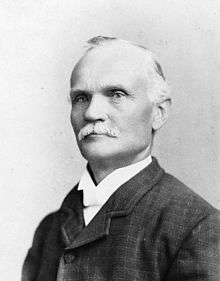 |
| There's a handsome guy. |
Mormon Literature Sampler:
How I Became a "Mormon"
Only in compliance with the counsel of President F. D. Richards have I reluctantly yielded to the repeated solicitations of the editor to relate briefly in the columns of the Era the incidents preceding and accompanying my conversion to the great work of the latter days, and my baptism into The Church, at Dresden, Saxony, October 14, 1855.
As "Oberlehrer" at the Budich Institute, Neustadt, Dresden, I, like most of my fellow-teachers in Germany, had become imbued with the scepticism that characterizes to a large extent the tendency of modern higher education, but I was realizing at the same time the unsatisfactory condition of a mind that has nothing to rely on but the ever changing propositions of speculative philosophy.
Although filled with admiration of the indomitable courage, sincere devotion, and indefatigable energy of the great German Reformer, Martin Luther, I could not fail to see that his work had been merely all initiatory one, and that the various protestant sects, taking their initiative from the revolutionary stand of the heroic monk at Wittenberg and Worms, had entirely failed to comprehend the mission of the reformation. The only strength of Protestantism seemed to be its negative position to the Catholic church; while in most of the positive doctrines of the multifarious protestant sects their antagonism to one another culminated only too often in uncompromising zealotry. These ideas illustrate in the main my views on religious subjects, at that time, and are explanatory of the fact that scepticism had undermined the religious impressions of my childhood days, and why infidelity, now known by its modern name as agnosticism, was exercising its disintegrating influence upon me.
In that dark period of my life, when I was searching for a foothold among the political, social, philosophical, and religious opinions of the world, my attention was called to a pamphlet on the "Mormons," written by a man named Busch. The author wrote in a spirit of opposition to that strange people, but his very illogical deductions and sarcastic invectives aroused my curiosity, and an irresistible desire to know more about the subject of the author's animadversion caused me to make persistent inquiries concerning it. There were no "Mormons" in Saxony at that time, but, as I accidentally found in an illustrated paper, they had a mission in Denmark. Through an agent, I obtained the address of Elder Van Colt, then President of the Scandinavian mission. My letter addressed to that gentleman brought the answer that neither he nor his secretary could understand much German, but that Elder Daniel Tyler, President of the Swiss and German mission at Geneva, would give me all information I should desire on the subject of "Mormonism." I addressed myself, therefore, to that gentleman.
What I now relate in this paragraph, I never learned until twelve years later, at Beaver City, Utah, where Brother Tyler related it in my presence, at a meeting of the Relief Society. When my letter arrived at Geneva, headquarters of the mission, one of the traveling Elders suggested to President Tyler to have nothing to do with the writer of the letter, but to send it back without any answer, as it was most likely only a trick of the German police to catch our possible connections in that country. President Tyler declared that as the letter was impressing him quite differently, he would send it back as suggested, but that it would come back again with more added to it, if the Lord was with the writer. Thus I got my letter back without any explanation or signature, only in a new envelope addressed to me. I felt insulted, and sent it with a few words of inquiries about this strange procedure, to Elder Van Cott, at Copenhagen. By return mail I received an apology from President Van Cott, stating that there must be a mistake somewhere, as Elder Tyler was a good and wise man. He had, however, sent my letter again to Geneva with an endorsement. This led to a long correspondence between Elder Tyler and myself. Pamphlets and some books were forwarded to me. Having some conceited notions in those days about illiteracy, and no faith in Bible or religious doctrines, correspondence and publications had no other effect upon me than to convince me that "Mormonism" was a much bigger thing than I had anticipated. I therefore expressed a desire for having an Elder sent to me.
A few weeks after that request had been made, Elder William Budge, now President of Bear Lake Stake, arrived at my house. It was providential that such a man was the first "Mormon" I ever beheld, for, although scarcely able to make himself understood in German, he, by his winning and yet dignified personality, created an impression upon me and my family which was the keynote to an indispensable influence that hallowed the principles he advocated. After about eight weeks' sojourn in our family, during which time my brother-in-law, Brother Edward Schoenfeld, and wife, and another teacher at one of the public schools in Dresden, had become interested in the teachings of the "Mormon" Elder, Elder F. D. Richards, then President of the European mission, and Elder William Kimball, arrived in Dresden. A few interviews at which Elder Budge acted as interpreter, led to the baptism of eight souls in the river Elbe; the first baptisms after the order of the Church of Jesus Christ of Latter-day Saints in that country.
On coming out of the water, I lifted both of my hands to heaven and said: "Father, if what I have done just now is pleasing unto thee, give me a testimony, and whatever thou shouldst require of my hands I shall do, even to the laying down of my life for this cause."
There seethed to be no response to my fervent appeal, and we walked home together, President Richards and Elder Budge at the right and the left of me, while the other three men walked some distance behind us, so as to attract no notice. The other members of the family were baptized a few days later. Our conversation was on the subject of the authority of the Priesthood, Elder Budge acting as interpreter. Suddenly I stopped Elder Budge from interpreting President Richards' remarks, as I understood them, and replied in German, when again the interpretation was not needed as President Richards understood me also. Thus we kept on conversing until we arrived at the point of separation, when the manifestation as suddenly ceased as it had come. It did not appear to me as strange at all while it lasted, but as soon as it stopped, I asked Brother Budge what that all meant, and received the answer that God had given me a testimony. For some time afterwards, whenever I conversed with President Richards, in England, we could understand each other more readily than when I was conversing with others, or rather trying to converse, until my progress in the English language made this capacity unnecessary.
This is the plain statement of the power of the Holy Spirit manifested to me by the mercy of my Heavenly Father, the first one of the many that have followed, and that have corroborated the sincere conviction of my soul, that the Church of Jesus Christ of Latter-day Saints is of God and not of man.
*Karl G. Maeser (1828-1901), one of Mormondom's most beloved educators, was born in Meiszen, Saxony, Germany. Well educated, Dr. Maeser became a successful German educator. He was baptized into the Church in 1855, after which he resigned his position and moved with his family to London, where he labored among German-speaking residents, building up a branch of the Church. In 1856, he emigrated to Philadelphia, where he labored for the Church until 1860, then moved to Utah and began teaching school. In 1864 he was called to become tutor to Brigham Young's family. Later, in 1867, while he was serving as an organist for the Tabernacle Choir, he was called to preside over the Swiss and German mission, where he founded the Church journal, Der Stern. In 1876 Brigham Young called Dr. Maeser to establish the Brigham Young Academy in Provo, Utah (later BYU), where he worked until his death, a leader in the Church Sunday School system and in the higher education program of the Church. This account of his conversion was published in the 1889 Improvement Era.
from http://mldb.byu.edu/kgmaeser.htm
Thursday, July 19, 2012
Stories
So, there is a little thing I have been doing these past weeks that I neglected to tell you about. I don't really know why I didn't mention it, but I think it will be easier to explain in blog post format so it's OK. I been writing some short stories! Because, I just realized, what I really want to do is be a writer and that's not one of those things in which you graduate with a degree and then apply for jobs and work your way up; if you want to do it, you just do it. And I figure, this is my last little snippet of free time before school starts, and then I may be off on a mission, and then who knows, so I've just been churning 'em out and hoping they're good. I've finished two and three quarters short stories (meaning one full story and three quarters of one and half of two others). I am pretty proud of myself.
The thing is, though, I feel like I have no idea what makes a good story. I mean, I've been reading a lot of them lately for practice--ones that are famous and ones that have been recently published in prominent magazines & journals, etc. And I know what I like and what I don't like. But it's sort of difficult to tell whether my own stories are hitting the mark or not. I rented a textbook from the library called, Behind the Short Story: From First to Final Draft, which has been rather helpful. What I mainly wanted to do in this post was to share with you a few inspirational quotes on writing I've gathered from this book, as well as from other sources.
"I can't explain inspiration. A writer is either compelled to write or not. And if I waited for inspiration I wouldn't really be a writer." -Toni Morrison
". . . I don't believe much in style. In fact, most young writers screw themselves royally when they make a conscious effort at style. They overdo the metaphors and adverbs and clever phrases. They call attention to themselves, relentlessly, rather than to the fictional world they're trying to create. I'm not suggesting that writers should ignore the beauty and elegance of the language. But I am suggesting that such beauty and elegance must emerge organically from an effort to tell the truth. Style is a function of the truth. It is not some free-floating gloss you can dump on your work to make it shine. If you force your characters to face their darkest truths, the language of the story will naturally rise into the lyric register. It will have to do so, in order to express the depth of their feelings." -Steve Almond
"I want stories to startle and engage me within the first few sentences, and in the middle to widen or deepen or sharpen my knowledge of human activity, and to end by giving me a sensation of a completed statement." -John Updike
"The fiction writer has to realize that he can't create compassion with compassion, or emotion with emotion, or thought with thought. He has to provide all these things with a body; he has to create a world with weight and extension." -Flannery O'Connor
Also, there is a pretty cool thing I have learned already about writing. While it is easiest to come up with stories based on my own experience, I feel like those stories often end up boring and go nowhere. When I write a main character that is basically me, I don't know how to make the story interesting, even though I feel like my own feelings are very interesting. (The two stories that have stalled at half-finished are basically about me.) I have concluded that it is most fun for me as a writer to try to imagine someone very different from myself. So that accords with these wise words from C. Day Lewis: "We do not write in order to be understood; we write in order to understand."
So anyway. By the end of this summer--mark my words--I will have a catalogue of mediocre stories! Then I will make them better, then I will submit them to BYU's literary magazine and writing contests, then depending on how that goes I will submit them to real literary magazines and writing contests, then I will be a real live writer and my life will be complete.
The thing is, though, I feel like I have no idea what makes a good story. I mean, I've been reading a lot of them lately for practice--ones that are famous and ones that have been recently published in prominent magazines & journals, etc. And I know what I like and what I don't like. But it's sort of difficult to tell whether my own stories are hitting the mark or not. I rented a textbook from the library called, Behind the Short Story: From First to Final Draft, which has been rather helpful. What I mainly wanted to do in this post was to share with you a few inspirational quotes on writing I've gathered from this book, as well as from other sources.
"I can't explain inspiration. A writer is either compelled to write or not. And if I waited for inspiration I wouldn't really be a writer." -Toni Morrison
". . . I don't believe much in style. In fact, most young writers screw themselves royally when they make a conscious effort at style. They overdo the metaphors and adverbs and clever phrases. They call attention to themselves, relentlessly, rather than to the fictional world they're trying to create. I'm not suggesting that writers should ignore the beauty and elegance of the language. But I am suggesting that such beauty and elegance must emerge organically from an effort to tell the truth. Style is a function of the truth. It is not some free-floating gloss you can dump on your work to make it shine. If you force your characters to face their darkest truths, the language of the story will naturally rise into the lyric register. It will have to do so, in order to express the depth of their feelings." -Steve Almond
"I want stories to startle and engage me within the first few sentences, and in the middle to widen or deepen or sharpen my knowledge of human activity, and to end by giving me a sensation of a completed statement." -John Updike
"The fiction writer has to realize that he can't create compassion with compassion, or emotion with emotion, or thought with thought. He has to provide all these things with a body; he has to create a world with weight and extension." -Flannery O'Connor
Also, there is a pretty cool thing I have learned already about writing. While it is easiest to come up with stories based on my own experience, I feel like those stories often end up boring and go nowhere. When I write a main character that is basically me, I don't know how to make the story interesting, even though I feel like my own feelings are very interesting. (The two stories that have stalled at half-finished are basically about me.) I have concluded that it is most fun for me as a writer to try to imagine someone very different from myself. So that accords with these wise words from C. Day Lewis: "We do not write in order to be understood; we write in order to understand."
So anyway. By the end of this summer--mark my words--I will have a catalogue of mediocre stories! Then I will make them better, then I will submit them to BYU's literary magazine and writing contests, then depending on how that goes I will submit them to real literary magazines and writing contests, then I will be a real live writer and my life will be complete.
Thursday, July 12, 2012
This is a record: Three posts in a row for Carla. Ok. I found the best music video ever. By best I mean most bizarre. Here it is: http://www.youtube.com/watch?v=lcOxhH8N3Bo
Thursday, July 5, 2012
I told you the guidebooks were bad, but today I found an especially . . . artistic passage in one of the free brochures. "Siena has been compared to the neck of an amphora, an arrowhead, a ship ready to sail, a hand poised atop the hills, an Etruscan tripod and a bow stretched to the breaking point. Piazza del Campo has been likened to a sundial, a navel, a womb, a shell, a pool the Virgin's open cape, a soap bubble (okay...) and opalescent crystal. And again, the cathedral has been described as a sailing ship, and its facade as a forest of symbolism.
They just keep getting better.
They just keep getting better.
Friday, June 22, 2012
Greetings from Italy!!!!!!! Just a note, I really hate how blogger redid their whole layout because now everything seems unfamiliar to me. I don't know why I am so irked.
Italy is great! This is a stupid thought, really, but I must express it. I can't believe how many people here speak Italian. I just want to go up to a fluent speaker and say, "Do you know you are speaking Italian right now, fluently in a way I have hardly heard it spoken before? Do you know you are ITALIAN?" But I refrain.
 Anyways, I wanted to tell you that I got a library card here! The Siena public library and I are going to have a good time. Yah. :) Also, they have so many books by F.Scott Fitzgerald at the library, all in Italian. They have more books by him than I saw at our public libraries back home. So here's a picture as proof. It's a really bad picture, but I took it just for you.
Italy is great! This is a stupid thought, really, but I must express it. I can't believe how many people here speak Italian. I just want to go up to a fluent speaker and say, "Do you know you are speaking Italian right now, fluently in a way I have hardly heard it spoken before? Do you know you are ITALIAN?" But I refrain.

Monday, May 14, 2012
It is a good thing I was not alive in MTV's heyday, because I would never have accomplished anything. I sat down an hour ago to write this paper about Jungian psychology in Pride and Prejudice but instead I just watched a long series of 80s music videos on YouTube. I would like to share my finds with you in the form of a tribute to my new idol, Bunty.
Joining the ranks of the incredible Patti Boyd (the woman who inspired both George Harrison's "Something" and Eric Clapton's "Wonderful Tonight"), Bunty Bailey is obviously a contender for the title of coolest lady on earth because she stars in the videos for both A-Ha's "Take on Me" and The Outfield's "Your Love." According to this blog I happened upon, Bunty dated Morton Harket (comic-book singer guy from video #1) and "Harket and Bailey continued the relationship until after rumors Bunty dumped the popstar for the English punk-pop artist Billy Idol."
So I now present, for your viewing pleasure, some videos. I find the first video superior in its story and aesthetics, but I like the second song better.
Joining the ranks of the incredible Patti Boyd (the woman who inspired both George Harrison's "Something" and Eric Clapton's "Wonderful Tonight"), Bunty Bailey is obviously a contender for the title of coolest lady on earth because she stars in the videos for both A-Ha's "Take on Me" and The Outfield's "Your Love." According to this blog I happened upon, Bunty dated Morton Harket (comic-book singer guy from video #1) and "Harket and Bailey continued the relationship until after rumors Bunty dumped the popstar for the English punk-pop artist Billy Idol."
So I now present, for your viewing pleasure, some videos. I find the first video superior in its story and aesthetics, but I like the second song better.
Wednesday, April 25, 2012
Yet Another Historical Hunk
So, it feels like these guys are all I have been posting lately. I promise hunks are not all I think about. (Maybe they are.)
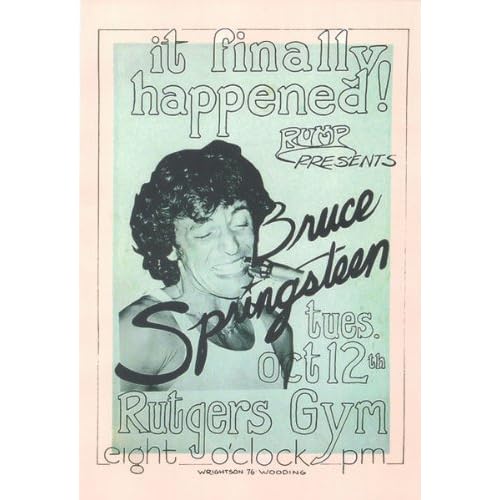
But I couldn't pass up this opportunity to beautify the blog. BEHOLD, Bruce Springsteen.
Watch these both, okay? It would be a good use of your time, because the music is excellent as well.
Also, I am pretty sure I am going to purchase this poster so that it will hang in our room next year, right beside Bob Dylan and his rainbow hair. Whaddya say.

But I couldn't pass up this opportunity to beautify the blog. BEHOLD, Bruce Springsteen.
Also, I am pretty sure I am going to purchase this poster so that it will hang in our room next year, right beside Bob Dylan and his rainbow hair. Whaddya say.
Tuesday, April 24, 2012

Accorded Site of Special Scientific Interest status in 1961, the Siccar Point unconformity (known as Hutton’s Unconformity) is an internationally famous place of geological pilgrimage. It is of great historical importance in the development of the science of geology.
In 1788, James Hutton first understood the significance of the geological structure at Siccar Point. Although not the first unconformity he had observed, it is certainly the most spectacular. The near vertical Llandovery (Silurian) age greywackes and shales are covered unconformably by gently dipping Upper Devonian or Lower Carboniferous red breccia and sandstones. (Wow! Upper devonian and Lower carboniferous red breccia!!)
Stop number 2: I heard about this on NPR while driving to Moab.
http://www.bbc.co.uk/newsround/17816645
Will and Grace would love this!!
Thursday, April 12, 2012
Historical Hunk, Third (Fourth?) Edition
I know you don't agree, but I'm posting his face all up in here anyway:


 Pete Townshend. He's not really attractive, but there's something just very interesting about his face. I can't explain (Ha ha).If you're not into huge noses, perhaps you'd go for the baby-faced, puppy dog-eyed likes of Keith Moon:


Or the ordinary but undeniable good looks of Roger Daltrey:

I'm afraid John Entwistle just doesn't have much going for him, but I'll include him just so he doesn't feel left out.

Wednesday, April 11, 2012
Band Names
Ok. We already know that I have a hard time staying...focused during church. I used to read the chapter headings to the Old Testament, but my selected activity this week was to search for band names in the Bible Dictionary. Here are a few that I have been thinking about.
Mt. Sinai
Solomon's Porch
Son of Man
Abner
Advocate (can you tell I looked at the s's and a's?)
Side note: the Apocrypha is chalkful (CHALKFUL!) of great band names. For example
Bel and the Dragon (I feel like this is already a band name and that is why I think it is so cool). The purpose of this story is to ridicule idolatry.
Book of Tobit
Book of Judith. Describes the murder of the Assyrian general Holofernes by Judith, a rich and beautiful widow of Betulia.
Book of Baruch
The History of Susanna: Daniel vindicates a young woman names Susanna against false charges.
So what do you think? My personal favorite is Bel and the Dragon.
Mt. Sinai
Solomon's Porch
Son of Man
Abner
Advocate (can you tell I looked at the s's and a's?)
Side note: the Apocrypha is chalkful (CHALKFUL!) of great band names. For example
Bel and the Dragon (I feel like this is already a band name and that is why I think it is so cool). The purpose of this story is to ridicule idolatry.
Book of Tobit
Book of Judith. Describes the murder of the Assyrian general Holofernes by Judith, a rich and beautiful widow of Betulia.
Book of Baruch
The History of Susanna: Daniel vindicates a young woman names Susanna against false charges.
So what do you think? My personal favorite is Bel and the Dragon.
Sunday, April 1, 2012

Friday, March 23, 2012
Yah, you posted some really good stuff. Now I want to read Youth and now I feel like a copycat. This is one of the many problems of having an English major friends, problems that multiply when you put two English major friends together. Going back to Youth, I feel pretty boring sometimes, especially when the weekend rolls around and I realize I neglected to plan anything "fun" to do. For example, it's seven o-clock on a Friday night and I am typing this blog post while laying in my bed in pajamas. After this I think I am going to take a nap. I don't feel bad about this. These things give me pleasure, but perhaps, like T.S. Elliot, I am dull. Oh well. (this post is really going to be a hodgepodge of things I have been thinking about. I'll briefly outline what's going to be in it: English major friends, what I'm learning as opposed to what you are learning, asking questions and I need a book to read).
Problems with having English Major friends:
1) You realize how utterly dismal your grammar is and your friends are more than willing to point that out. They try and elucidate you by stating confusing example sentences that involve you picking your nose and your picking your nose. Either way someone is picking their nose, right?
2) You just want to furtively read everything they are reading and pretend you thought about reading that great book all on your own.
3) That's all. Mostly there are only benefits to have smart-as-a-whip English friends.
What I am learning as opposed to what you are learning:
Being in limbo between a history and Econ major made me assess what I would be learning in each type of major. It's kinda weird to me that in both majors I would definitely be learning a lot, but people give so much more credit to what I would be learning in Econ as opposed to History. I think it's because what I learn in Econ is pretty quantifiable. It's equations and models and numbers and effect of a price increase and how much money I'm making, etc. while what I'm learning in history just seems like this ambiguous nebulous that involves dates, people and lots of reading. It's hard to really pinpoint bundles of knowledge that I'm learning in history and my progress from step a to step b, while in Econ, I can tell you one day I learned about costs and the next day I learned about revenue and after that I'm going to learn about profits and then some consulting firm is going to snatch me up and hire me. So I think people tend to discredit fields of study that seem really vague to them because they can't decompose them so easily. They can't tell you exactly what is hard about history, so it's easy. Or if they find something hard about history, like writing a paper, they think writing a paper is the most useless thing in the world.
I guess this passage is starting to become my soapbox for people discrediting liberal arts and history majors. I can think of a lot of terms and equations that I could hurl at you and you wouldn't know what I'm talking about but you could look at a poem and understand so much more than I ever would. It's like you can look into this whole other literary world that I am just blind to. Sometimes I think econ majors can't see what liberal art majors see and so they unfairly give liberal art majors labels.
The other thing is, do you have any goods book I could read? I was going to read Middlemarch, but I'm in the mood for a more modern book. Written within the last one hundred years would be good.
Problems with having English Major friends:
1) You realize how utterly dismal your grammar is and your friends are more than willing to point that out. They try and elucidate you by stating confusing example sentences that involve you picking your nose and your picking your nose. Either way someone is picking their nose, right?
2) You just want to furtively read everything they are reading and pretend you thought about reading that great book all on your own.
3) That's all. Mostly there are only benefits to have smart-as-a-whip English friends.
What I am learning as opposed to what you are learning:
Being in limbo between a history and Econ major made me assess what I would be learning in each type of major. It's kinda weird to me that in both majors I would definitely be learning a lot, but people give so much more credit to what I would be learning in Econ as opposed to History. I think it's because what I learn in Econ is pretty quantifiable. It's equations and models and numbers and effect of a price increase and how much money I'm making, etc. while what I'm learning in history just seems like this ambiguous nebulous that involves dates, people and lots of reading. It's hard to really pinpoint bundles of knowledge that I'm learning in history and my progress from step a to step b, while in Econ, I can tell you one day I learned about costs and the next day I learned about revenue and after that I'm going to learn about profits and then some consulting firm is going to snatch me up and hire me. So I think people tend to discredit fields of study that seem really vague to them because they can't decompose them so easily. They can't tell you exactly what is hard about history, so it's easy. Or if they find something hard about history, like writing a paper, they think writing a paper is the most useless thing in the world.
I guess this passage is starting to become my soapbox for people discrediting liberal arts and history majors. I can think of a lot of terms and equations that I could hurl at you and you wouldn't know what I'm talking about but you could look at a poem and understand so much more than I ever would. It's like you can look into this whole other literary world that I am just blind to. Sometimes I think econ majors can't see what liberal art majors see and so they unfairly give liberal art majors labels.
The other thing is, do you have any goods book I could read? I was going to read Middlemarch, but I'm in the mood for a more modern book. Written within the last one hundred years would be good.
Tuesday, March 20, 2012

Can you believe our blog has as of yet no book reviews?
Well, I guess I can, because we are in school right now and don't read 4 fun. But this week is so low intensity for me academically that I read a whole book in two days. And I haven't finished formulating my thoughts about it yet, so I would just like to leave you with a few quotes from it for your digestion.
"After the interview he is given an IQ test. He has always enjoyed IQ tests, always done well at them. Generally he is better at tests, quizzes, examinations than at real life" (45).
"Now and again, for an instant, it is given to him to see himself from the outside: a whispering, worried boy-man, so dull and ordinary that you would not spare him a second glance. These flashes of illumination disturb him; rather than holding on to them, he tries to bury them in darkness, forget them. Is the self he sees at such moments merely what he appears to be, or is it what he really is? What if Oscar Wilde is right, and there is no deeper truth than appearance? Is it possible to be dull and ordinary not only on the surface but to one's deepest depths, and yet be an artist? Might T.S. Eliot, for instance, be secretly dull to his depths, and might Eliot's claim that the artist's personality is irrelevant to his work be nothing but a stratagem to conceal his own dullness?
"Perhaps; but he does not believe it. If it comes down to a choice between believing Wilde and believing Eliot, he will always believe Eliot. If Eliot chooses to seem dull, chooses to wear a suit and work in a bank and call himself J. Alfred Prufrock, it must be as a disguise, as part of the necessary cunning of the artist in the modern age" (116).
And the last two pages in their entirety.
As I record these quotes I realize that I really enjoyed this book, though at parts it was like a DAGGER through the HEART (in a good way).
Thursday, March 15, 2012
Reading is overrated?
I stumbled upon this while writing a statement of intent for grad school, which required me to ponder why I study literature and everything.
"Reading is Overrated" by Rick Gekowski (the guardian)
I've been thinking about reading, and (as one does) got my Google finger out, and have been going through "reading quotations". That is: what has been memorably claimed about reading, and by whom? It's an interesting and surprisingly infuriating process.
"Reading is Overrated" by Rick Gekowski (the guardian)
I've been thinking about reading, and (as one does) got my Google finger out, and have been going through "reading quotations". That is: what has been memorably claimed about reading, and by whom? It's an interesting and surprisingly infuriating process.
Take this, for example. Maxim Gorky once claimed that "everything which is good in me should be credited to books". You find this quoted a lot, as if it carried some generalisable weight. Yet I don't believe it can be true, quite, even of Maxim Gorky, who led an intermittently miserable life. It's a blind and callous thing to say. What about the influences of his family (particularly his grandmother), or his many friends? Nothing good whatsoever emanated from them? If I were his father I'd give him such a slap. You good-for-nothing thankless Gorky you, you book-ridden ingrate, you louse…
But, of course, one recognises this sort of overstatement. You have to feel passionately about a subject to talk this foolishly about it. An astonishing number of "lovers" of books and of reading frequently say similarly questionable things, at least if you quote them out of context – which is what people tend to do. I'm doing it too.
Let's take the following, by way of almost random example, from Charles Kingsley: "Except a living man, there is nothing more wonderful than a book." Gosh. Any living man? Any book? Nothing else can compete? Flowers? Sunsets? Palladian villas? Pastrami sandwiches with extra pickles? Rubbish. One remembers Norman Mailer's definition of a "conservative" as one who, given a choice between saving the life of a man and that of a tree, will ask to view the tree and to meet the man before making his decision. You have to look at what is in front of your nose, after all. It's not too much to ask.
And then we have this, from Somerset Maugham: "To acquire the habit of reading is to construct for yourself a refuge from almost all of the miseries of life." Well, almost all? I wonder which miseries reading is a refuge from, and which not? And if it is such an escape, are we not likely to doubt that what we were protected from was not a misery, but an inconvenience or an occasional source of bad temper? I suspect that a good definition of "misery" might well be "pain so acute that even reading will not assuage it". I'd be surprised if reading provided a "refuge" from the pains of toothache, colic, or childbirth, the deaths of loved ones, the decline into dementia, the experience of war, famine, or grinding poverty, or the relegation of Coventry City FC.
The difference between pain and pleasure is that the former overwhelms the latter, but no amount of white truffles, operatic arias or sex will drive away the agony of a bad toothache, much less the pain of the death of a loved one. And a good book certainly won't get close. Why claim that it might, or can? This seems to me to signal the same sort of doubts that underlie the most fervent of religious doctrines.
Or – if you will indulge me – whatever do you make of this? "He who destroys a good book kills reason itself." That is John Milton at his most unsatisfactory. Destroy a good book and you may destroy an instance of good reason, but presumably there are other copies of the book around to reassert it. Or maybe he means "(the only known copy of) a good book"? But that is simply silly. And though "reason" was then a more endangered form of discourse, even, than it is now, there's no reason to go all hysterical about the destruction of a given book, no matter how good. But "the destruction of one book presages the destruction of all"? Rubbish. Even at those occasional times and places where this has seemed to be true, and books have been burned, it has always turned out not to be. Reason, as shaky a foundation as it may be, is reassuringly capable of eventually withstanding the most profound shocks.
But, surely, reading widens and enhances our sense of life? That must be what Milton is driving at? It is a common enough motif. Here are two nice examples:
"Reading maketh a full man." (Francis Bacon)
"We read to know we are not alone." (CS Lewis)
You feel sympathetic to the underlying feeling, but – honestly! – what total cod. These are the sort of sentiments that headmasters of the dreariest type express at parents' evenings. And what an appalling set of implications is posited for the unlettered, however kindly of disposition, whatever their achievements in the humble reaches of the heart. You can't read? Then, implies Mr Lewis, you presumably believe that we are alone? Poor old illiterates, stripped in a trice of the love and affection of friends and family, sundered from a God whom one does not have to read about to believe in. And presumably it is at least an implication of Bacon's dictum that our poor illiterate lonely hordes are neither companied nor "full", for reading accomplisheth fullness.
I know what I think this is full of. Of arrogance, and pomposity, and what Philip Larkin liked to call the smell of bum. Here's a nice little exercise: find a book, or an article, or a website that has quotes about "books", or "reading", or "literature". Look through the examples, and ask yourself how many of these self-consciously citeable sentiments actually make sense? Because the instances I have quoted are chosen almost casually from a myriad competing instances of overstatement, false generalisation, self-congratulation and self-deception, pure silliness, inanity.
To see intelligent persons expressing themselves in such a loose and foolish manner elsewhere, you have to look at similarly dubious encomia regarding God, or love, or politics. To become this stupid you have to care a lot. I know, of course, that such condensed statements are tropes, and rallying cries. We talk like this, with this unconditioned enthusiasm, about what we most care about, and wish everyone to share. We over-simplify and hyperbolise in the hope of convincing both ourselves and others. This is rhetoric, which is too often the opposite of thinking.
One might argue that literacy is unalloyedly a good thing – yes, I can think of counter-examples, but then again one always can – but it is pretty clear to me that reading, as in reading of literature, is not. What we read can affect us vitally, penetrate, stimulate and inform us, but not always in the right ways, or at the right times, or about the right things.
If you think that reading the right things in the right ways is morally bracing, improves one's discriminations and heightens sensitivity – basically, the Leavis line – then all you have to do is look at the behaviour of Dr Leavis himself to begin to doubt the thesis. Indeed, if it were true that wide and deep reading redounds wholly positively on the development of a wholesome self, consider a typical member of a university English department, and despair.
I come from a country in which it is widely felt that there is no problem so intractable that a slogan won't solve it. "Say No to Drugs!" (This in the most neurotically hyper-medicated country in the world.) Or "It's Good to Read!" As if reading were a tonic, form of exercise, or vegetable. But the notion of seeking what is "good for you" is somehow thin and inadequate here, as if drawn from the vocabulary of an evangelical huckster, personal trainer, or nutritionist.
Reading is more important than that. Sometimes we are enhanced by it, at others diminished. We need to be able to think carefully about this, and to talk about it more accurately. As Larkin put it: "I should never call myself a book lover any more than a people lover. It all depends what's inside them."
If there seems something nit-picky and literal minded about my responses to our reading sages – seems like it even to me – it is because I am out of patience with generalisation and high rhetoric, with those forms of discourse that are heavily dependent on the verb to be: A book is this or that. The essence of reading is the following. The nature of x is y.
I don't want to go all Wittgensteinian on you – at least not here – but there are surely better ways to talk about, and to recommend, those things that most matter to us. To keep to the text or the question, to distinguish difference rather than posit similarity, to avoid generalisation. To particularise. To keep one's eye, and finger, on the page.
Monday, February 27, 2012
This is a stupid way to tell you, probably worse than texting, but I am in a stupid, lame mood.
As my title to eloquently puts it, I am in a stupid, lame mood. And the reason is the quintessential nineteen-year old anguish: My boyfriend broke up with me.
As soon as it happened I told Mike to take me to your house, but when I walked into your house ready to tell you the dismal news, I promptly slipped down the stairs, making me feel more stupid and lame and your house was so chalkful full of roommates, boyfriends and interviewers (of all nights to have some strange interviewer in your house...geeze, my luck really runs low these days) that I didn't feel like saying anything. I just did what I did best. Pretend to be asleep on the couch and then get up and leave. I called my house at eleven thirty, told Paul to wake up Dad because it was an emergency and then proceeded to yell at my dad for things he had nothing to with while he so patiently listened. I also wandered the south streets of Provo for half an hour.
I don't really know what went wrong, but I'm glad we are not trying to "make things work." I only cried for about .3 seconds, and then decided I didn't want to cry about a stupid boy. Ok. That was mean. But I feel like being mean. I feel like being a terrible person because then I would get why he broke up with me instead of his reason that he just feels like it's not working. Am I a hard person to work with?
I am also being torn right now because all I can think about is not how sad I am that I was just dumped, but how sad I am that Robert is not here. Even today as I received his weekly email and looked at the picture he sent me while cleaning up my desk I thought, "If Robert were here, I would be dating him." If he were here, this wouldn't have happened! I don't know if I miss Robert so much because I just got dumped or because I really really like him. Right now I don't think I am in a steady emotional state (this reminds me of the steady-state of GDP we learn about in economics. In order to get out of the steady state you need to inject technological growth into the equation. This now has nothing to do with how I am feeling, so I am going to get back on topic. Also, I am just throwing words on a page right now because I am sad and mad and determined to say something, so if you want to skip to the end of this post, that's ok). Tellingly, the first thing I did when I got back to my apartment was play the CDs Robert made for me. Everything was so perfect with Robert, but then again I thought things were going great with Mike, so let's not fool ourselves.
I feel duped. I feel like I was the flavor of the month at Baskins and Robbins and then got switched out once Superman Birthday Cake was not so exciting of a flavor anymore. And I feel justified in feeling this way because Mike told me he just wasn't enjoying dating me as much as he used to. He used to "genuinely look forward" to seeing me at the end of the day, and now, just not so much. So I feel swindled and scammed and stupid that I was that girl that some guy "just dated for a month."
I'm going to make a list of things I don't like because I feel like it.
1) I don't like boys who date
2) I don't like couples at BYU
3) I don't like pregnant ladies waddling around on campus
4) I don't like babies in the library
5) I don't like missions and how they took away my best friends and will then proceed to take away all my girl friends within the next year.
6) I don't like eight 0'clock classes
7) I don't like how Vanesa turns our thermostat up to 80 degrees every morning, warms up her tea in the microwave and turns on the kitchen light, a combination that is guaranteed to wake up me somehow even if I wear earplugs and a sleeping mask and take my pajama pants off and wrap them around my head to further muffle the noise.
8) I don't like how my knee hurts
9) I don't like going to pointless emergency preparedness meetings
10) I don't like grading 45 econ midterms.
11) I don't like how Mike is in my History 200 class for the rest of the semester and how we are both history majors. Just leave me alone, gosh. (not you, him)
So there you have it: Carla in a dark, stormy mood. I can't even tell you why I'm not sad. I feel like I never will be. I'm just mad. Also, I feel like crap because I already wrote my Dear John to Robert. I'm not going to ask him if we can start writing again, because it's rude just to take him along the ride of my dating life, but I want to tell him how I feel about him. Maybe he feels like the way I do now and doesn't really care if my house gets egged tomorrow.
The other thing is, I'm not even tired and I have to wake up in less than six hours. Hmph.
Please don't tell Jordan. I'm not embarrassed, but I just want to tell her myself. Thanks.
As soon as it happened I told Mike to take me to your house, but when I walked into your house ready to tell you the dismal news, I promptly slipped down the stairs, making me feel more stupid and lame and your house was so chalkful full of roommates, boyfriends and interviewers (of all nights to have some strange interviewer in your house...geeze, my luck really runs low these days) that I didn't feel like saying anything. I just did what I did best. Pretend to be asleep on the couch and then get up and leave. I called my house at eleven thirty, told Paul to wake up Dad because it was an emergency and then proceeded to yell at my dad for things he had nothing to with while he so patiently listened. I also wandered the south streets of Provo for half an hour.
I don't really know what went wrong, but I'm glad we are not trying to "make things work." I only cried for about .3 seconds, and then decided I didn't want to cry about a stupid boy. Ok. That was mean. But I feel like being mean. I feel like being a terrible person because then I would get why he broke up with me instead of his reason that he just feels like it's not working. Am I a hard person to work with?
I am also being torn right now because all I can think about is not how sad I am that I was just dumped, but how sad I am that Robert is not here. Even today as I received his weekly email and looked at the picture he sent me while cleaning up my desk I thought, "If Robert were here, I would be dating him." If he were here, this wouldn't have happened! I don't know if I miss Robert so much because I just got dumped or because I really really like him. Right now I don't think I am in a steady emotional state (this reminds me of the steady-state of GDP we learn about in economics. In order to get out of the steady state you need to inject technological growth into the equation. This now has nothing to do with how I am feeling, so I am going to get back on topic. Also, I am just throwing words on a page right now because I am sad and mad and determined to say something, so if you want to skip to the end of this post, that's ok). Tellingly, the first thing I did when I got back to my apartment was play the CDs Robert made for me. Everything was so perfect with Robert, but then again I thought things were going great with Mike, so let's not fool ourselves.
I feel duped. I feel like I was the flavor of the month at Baskins and Robbins and then got switched out once Superman Birthday Cake was not so exciting of a flavor anymore. And I feel justified in feeling this way because Mike told me he just wasn't enjoying dating me as much as he used to. He used to "genuinely look forward" to seeing me at the end of the day, and now, just not so much. So I feel swindled and scammed and stupid that I was that girl that some guy "just dated for a month."
I'm going to make a list of things I don't like because I feel like it.
1) I don't like boys who date
2) I don't like couples at BYU
3) I don't like pregnant ladies waddling around on campus
4) I don't like babies in the library
5) I don't like missions and how they took away my best friends and will then proceed to take away all my girl friends within the next year.
6) I don't like eight 0'clock classes
7) I don't like how Vanesa turns our thermostat up to 80 degrees every morning, warms up her tea in the microwave and turns on the kitchen light, a combination that is guaranteed to wake up me somehow even if I wear earplugs and a sleeping mask and take my pajama pants off and wrap them around my head to further muffle the noise.
8) I don't like how my knee hurts
9) I don't like going to pointless emergency preparedness meetings
10) I don't like grading 45 econ midterms.
11) I don't like how Mike is in my History 200 class for the rest of the semester and how we are both history majors. Just leave me alone, gosh. (not you, him)
So there you have it: Carla in a dark, stormy mood. I can't even tell you why I'm not sad. I feel like I never will be. I'm just mad. Also, I feel like crap because I already wrote my Dear John to Robert. I'm not going to ask him if we can start writing again, because it's rude just to take him along the ride of my dating life, but I want to tell him how I feel about him. Maybe he feels like the way I do now and doesn't really care if my house gets egged tomorrow.
The other thing is, I'm not even tired and I have to wake up in less than six hours. Hmph.
Please don't tell Jordan. I'm not embarrassed, but I just want to tell her myself. Thanks.
Sunday, February 26, 2012
Mariategui

I would like to add someone to our historical hunks gallery: Jose Carlos Mariategui (there should be accents here, but I don't want to change my keyboard to Spanish).
Behold the man considered to be the father of Latin American Marxism. He believed that Marxism in Latin America should develop through indigenous roots instead of through forcing a prescriptive European model of socialism on Latin American countries. He died at age 35, so the amount of influence he has had in Latin America is pretty amazing. I think he has rather striking features. He spent some time in Italy, which is cool. His travels merge my two favorite countries!
Friday, February 24, 2012
Historical Hunk, Second Edition

Behold: our current historical hunk. I will allow Wikipedia to say some things about him I don't care about:
Søren Aabye Kierkegaard (English pronunciation: /ˈsɔrən ˈkɪərkəɡɑrd/ or /ˈkɪərkəɡɔr/; Danish: [ˈsɶːɐn ˈkiɐ̯ɡəɡɒːˀ] ( listen)) (5 May 1813 –11 November 1855) was a Danish philosopher, theologian and religious author. He was a critic of idealist intellectuals and philosophers of his time, such as Georg Wilhelm Friedrich Hegel, Friedrich Wilhelm Joseph Schelling and Karl Wilhelm Friedrich Schlegel. He was also critical of the state and practice of Christianity, primarily that of the Church of Denmark. He is widely considered to be the first existentialist philosopher.
listen)) (5 May 1813 –11 November 1855) was a Danish philosopher, theologian and religious author. He was a critic of idealist intellectuals and philosophers of his time, such as Georg Wilhelm Friedrich Hegel, Friedrich Wilhelm Joseph Schelling and Karl Wilhelm Friedrich Schlegel. He was also critical of the state and practice of Christianity, primarily that of the Church of Denmark. He is widely considered to be the first existentialist philosopher. And Roy Orbison to say the thing I do care about:
"Don't cut your hair, whatever you do
I need it to run my fingers through"
That's really the only part that applies.
Friday, February 17, 2012
Please think this is as funny as I think it is.
I received this email in my inbox with the subject line of Funny. I always start laughing when I see it out of the corner of my eye as I'm scrolling my inbox. It's just so funny. Imagine my mom animatedly telling you this story. Emphasis added.
I have to tell you what happened yesterday. Dad was helping with Blue and Gold event yesterday at church. He took strawberries as a side dish. He told us the food was going to be tacos. He told us to go there to have dinner. When Paul came back from selling cookie dough and stuff for his baseball fundraising at around 6:15 p.m. We got ready and Paul, Ben and I left and headed to the Stake Center. We got there and the gym had a Hawaiian theme decoration. It was amazing. It felt like we actually were in a nice tropical Island. We didn't see dad serving the food. We were thinking that dad got mixed up (it wasn't tacos like he told us) We went ahead and served ourselves Hawaiian delicious food. (My mom is super-excited about this Hawaiian theme) I said hi to bro. George and other people in line and talked about how nice they've decorated the gym. Paul got to talk to Daniel George. Then he went to the kitchen to see dad. In the meantime Ben and I got our food and went to a table. I noticed the kid beside me was eating strawberries but how strange, these had the green part on it (dad had taken off the green part to the strawberries he took). Any way, when we were chatting and eating our food Paul came and told us that dad was in our church building. The Blue and gold event was in our own ward and we had crash in in the George's ward. I was laughing so hard when Paul was saying "Mom, dad want us to go right away." Ben had finished his food and I had to take my plate with half of my food uneaten. On our way out I saw Bro. George and told him of our mistake. He just smiled and offer us dessert. Our ward theme was you're a hero and the decoration had balloons and blue and gold tablecloths. The food was tacos and I had one strawberry. It was good. I still laugh thinking of our confusion.
How are you doing? How is your sore knee these days?
Love,
Mom
How are you doing? How is your sore knee these days?
Love,
Mom
Thursday, February 16, 2012
Art for Pete's Sake
So, I don't know if you saw this month's Student Review, but I was reading it this afternoon and came across a fascinating interview with Jon McNaughton, the artist behind this painting,
which I first saw some time ago in the BYU bookstore basement and had to suppress an urge to vomit. Now, I'm all for the USA, and believe that the Constitution is wonderful and was, as they say, divinely inspired. But I do take issue with the extent to which Christ is here conflated with the U.S. government & founding fathers. I think that when Christ comes to earth, the message He delivers is going to be something other than the Constitution.
The article in the Student Review centered on a more recent painting of McNaughton's, which looks like this,

and is equally maddening. Not because I worship Obama, though I definitely think this painting villainizes him unnecessarily. In fact, it took me reading more of McNaughton's comments below this picture where I found it online to realize why I really fundamentally hate these pictures: “I’m not trying to create an art style," he says. "I want to communicate my ideas. Isn’t that the purpose of art?”
which I first saw some time ago in the BYU bookstore basement and had to suppress an urge to vomit. Now, I'm all for the USA, and believe that the Constitution is wonderful and was, as they say, divinely inspired. But I do take issue with the extent to which Christ is here conflated with the U.S. government & founding fathers. I think that when Christ comes to earth, the message He delivers is going to be something other than the Constitution.
The article in the Student Review centered on a more recent painting of McNaughton's, which looks like this,
and is equally maddening. Not because I worship Obama, though I definitely think this painting villainizes him unnecessarily. In fact, it took me reading more of McNaughton's comments below this picture where I found it online to realize why I really fundamentally hate these pictures: “I’m not trying to create an art style," he says. "I want to communicate my ideas. Isn’t that the purpose of art?”
Is it? The very fact that he would ask that question kind of rubs me the wrong way; if he went through the entire BFA program at BYU (which he did, according to a the Student Review interview), shouldn't he have developed a slightly more complicated conception of "the purpose of art"--if there even is a purpose? Oscar Wilde would certainly take issue with that. Actually, I'm sure there are almost as many ideas of the purpose of art as there are people, and it's not as if I am an expert. But to say it's purpose is to communicate his ideas--his political ideas, nonetheless--does seem much too facile.
I think the first criteria for art should be: Is it pretty? And I don't think Mr. McNaughton's work is very. After that, we can ask ourselves what the artist is trying to say or whatever, if he or she wants to say something. And if conveying a message is your goal, artist, at least don't insult your viewers by making the work's meaning so sickeningly obvious.
“I hope my work will create conversation and reach people on a deeper level,” McNaughton says on his website. “I like to use metaphor and multiple levels of meaning to reach my viewer. If it makes them think and feel, then it is successful.” Wow--so deep!--I wonder what you could be trying to say by depicting Obama with his foot on the Constitution while Roosevelt and Clinton, standing at his left, clap in the background? These are metaphors that a fourth-grader could interpret upon his or her introduction to figurative language.
So I may not be able to articulate exactly what constitutes good art, but I'm pretty sure that this stuff is bad.
Tuesday, February 14, 2012
Happy Valentines Day
I was feeling really good about Valentines Day until just barely. Emily received her valentine from Jeff and I read it aloud at her behest and was so genuinely thrilled for her love; I made the sweetest cutest valentines for my roommates; I was so excited to participate in some alternative Valentine's traditions of my own. Because I truly do believe that this is a good occasion to express love for everyone in my life that I love. But about one hour ago, I just got inconsolably sad, and I was not expecting that. And I want someone to, like, comfort me and care about me and ask me how I'm feeling, but I don't think that I would tell them, anyway. I wanted to write this in my journal, but I also wanted to tell another person, so this is kind of a happy medium. (Warning: Please never post this blog address on your Facebook profile or resume or anything. Don't let anyone read it. If you don't even read it anymore, that is fine; I would like only to maintain the illusion of sharing my deep, pathetic feelings with someone other than me.)
So that is what brings me here. I would like to share my uncharacteristically non-uplifting or educational sentiments. I am just upset, and would like to rant about Valentine's Day of all things, which I HATE because I LOVE Valentine's day and HATE when people get angry about it and bitterly proclaim "Single Awareness Day." But then, perhaps the reason I hate that attitude in others is that I think only I actually have a right to be upset. The only thing more pathetic than me right now is me in twenty years when I am forty years old, still unkissed and unloved. I suppose you could say that, this evening, every romantic frustration I've felt in my entire life has been compacted into one miserable funk hanging around me. Do you want to know something completely ridiculous? I just googled "how to seduce your co-worker." It is so bad, Carla; save me from myself.
So that's one thing factoring into my anger: my coworker, even though I might say things are going sort of well on that front; I could write out a list for you of every interaction between us that made me giddy and convinced me he's in love with me, but that would distract from the melancholy mood of this post. And that, too, is beside the point. I have thought long and hard about this budding relationship, and concluded that I need this kid to love me for a few reasons. Obviously, I'd like to be convinced that I can make him love me. Also, if I can do it, it will be the ultimate victory because I will have done it 100% on the merit of my own charm. Developing a relationship in a foodservice atmosphere is comparable to doing physics problems that occur in a vacuum: no external forces, like existing mutual friends or my irresistibly luscious hair, are going to affect us. All we have to go on is how we look in our matching uniforms and green hats and how we react in stressful pizza-related situations. But on the other hand, it makes it one hundred times less likely that either of us will ever be able to ask the other to meet outside the pizza kitchen.
And there is another big problem, focused rather on my willingness to discuss this whole enterprise. I can't talk about it to anyone, because when it doesn't go anywhere, I can't let them know that I failed. Recall how I didn't really tell anyone about my first workplace love until I found out he was married? It was pretty strategic, though I didn't realize at the time. I had discovered that success was definitely impossible, but it wasn't my fault, so I could proclaim my unrequited love to the world and all was still well. Similarly, I want so badly to tell everyone every little detail of my discussions with current love interest, but, being the considerate friend I am, I prefer to protect everyone's fragile emotional states. I wouldn't want to dash all of your hopes to pieces.
Now, I'm shifting to examine my despair from a slightly different angle. I suppose you could say this is what motivated me to attempt the seduction in the first place. I know that everyone thinks I am super cool and everything; Caleb and my mom and all my Sunday School teachers and friends are simply at a loss to explain how I have never had a boyfriend, because I'm just so wonderful, right? And for the last two-ish years, that has made me feel sufficiently good about myself, I think. Recently, though, I decided that I have to stop being satisfied with everyone else being perplexed by me and actually show them some sort of answer. Me as a walking contradiction is kind of fun (or at least more fun than having everyone think, "Oh, yeah, she's pretty boring and awkward. No wonder boys don't care for her"), but I have---to---get---past---it----
I feel like Colonel Brandon from Sense and Sensibility, of whom Mr. Willoughby says, "He's the kind of man everyone speaks well of, but no one remembers to talk to."
Okay, just tell me when to stop. Really. I might be able to kvetch about this for pages. I'm going to conclude with this song that feels like a really good Valentine's song right now, for some reason.
Finally, I would like to say that I will appreciate any nice, comforting comments you would like to leave on this post, but ultimately the only thing that will satisfy me right now is a whole slew of boys from my past appearing on my doorstep to say that they all loved me for years and never told me. I would accept letters from them, even.
So that is what brings me here. I would like to share my uncharacteristically non-uplifting or educational sentiments. I am just upset, and would like to rant about Valentine's Day of all things, which I HATE because I LOVE Valentine's day and HATE when people get angry about it and bitterly proclaim "Single Awareness Day." But then, perhaps the reason I hate that attitude in others is that I think only I actually have a right to be upset. The only thing more pathetic than me right now is me in twenty years when I am forty years old, still unkissed and unloved. I suppose you could say that, this evening, every romantic frustration I've felt in my entire life has been compacted into one miserable funk hanging around me. Do you want to know something completely ridiculous? I just googled "how to seduce your co-worker." It is so bad, Carla; save me from myself.
So that's one thing factoring into my anger: my coworker, even though I might say things are going sort of well on that front; I could write out a list for you of every interaction between us that made me giddy and convinced me he's in love with me, but that would distract from the melancholy mood of this post. And that, too, is beside the point. I have thought long and hard about this budding relationship, and concluded that I need this kid to love me for a few reasons. Obviously, I'd like to be convinced that I can make him love me. Also, if I can do it, it will be the ultimate victory because I will have done it 100% on the merit of my own charm. Developing a relationship in a foodservice atmosphere is comparable to doing physics problems that occur in a vacuum: no external forces, like existing mutual friends or my irresistibly luscious hair, are going to affect us. All we have to go on is how we look in our matching uniforms and green hats and how we react in stressful pizza-related situations. But on the other hand, it makes it one hundred times less likely that either of us will ever be able to ask the other to meet outside the pizza kitchen.
And there is another big problem, focused rather on my willingness to discuss this whole enterprise. I can't talk about it to anyone, because when it doesn't go anywhere, I can't let them know that I failed. Recall how I didn't really tell anyone about my first workplace love until I found out he was married? It was pretty strategic, though I didn't realize at the time. I had discovered that success was definitely impossible, but it wasn't my fault, so I could proclaim my unrequited love to the world and all was still well. Similarly, I want so badly to tell everyone every little detail of my discussions with current love interest, but, being the considerate friend I am, I prefer to protect everyone's fragile emotional states. I wouldn't want to dash all of your hopes to pieces.
Now, I'm shifting to examine my despair from a slightly different angle. I suppose you could say this is what motivated me to attempt the seduction in the first place. I know that everyone thinks I am super cool and everything; Caleb and my mom and all my Sunday School teachers and friends are simply at a loss to explain how I have never had a boyfriend, because I'm just so wonderful, right? And for the last two-ish years, that has made me feel sufficiently good about myself, I think. Recently, though, I decided that I have to stop being satisfied with everyone else being perplexed by me and actually show them some sort of answer. Me as a walking contradiction is kind of fun (or at least more fun than having everyone think, "Oh, yeah, she's pretty boring and awkward. No wonder boys don't care for her"), but I have---to---get---past---it----
I feel like Colonel Brandon from Sense and Sensibility, of whom Mr. Willoughby says, "He's the kind of man everyone speaks well of, but no one remembers to talk to."
Okay, just tell me when to stop. Really. I might be able to kvetch about this for pages. I'm going to conclude with this song that feels like a really good Valentine's song right now, for some reason.
Finally, I would like to say that I will appreciate any nice, comforting comments you would like to leave on this post, but ultimately the only thing that will satisfy me right now is a whole slew of boys from my past appearing on my doorstep to say that they all loved me for years and never told me. I would accept letters from them, even.
Wednesday, February 8, 2012


Sunday, February 5, 2012
I finally figured it out.
I will recall to your memory our age-old question of why people always think about sex and how baffling it is that it pervades every form of media, communication and thought. I mean, why don't people think about ice cream that much? Why can you expect every joke that someone snickers at (is sniggers a word. i tried to type it, but spellcheck replaced it with snickers, which reminds me of the candy bar, which gets me thinking that that is a really weird name for a candy bar) to be about sex? My Very Short Introduction to History book by John H. Arnold finally shed some light on the matter.
First of all, as a basis, in this short little book one of the main points made is that a historian, or anyone for that matter, can never perfectly capture history because it is impossible for someone in the present to understand all the subtle nuances of the past and even then, each individual has unique experiences which makes it hard to piece individual accounts into a cohesive snapshot of "history" in that moment/year/decade, etc.... Point is: the human experience is really diverse. So what do we have in common? Three main things:
1) Birth. We were all born
2) Death. We all die
3) Sex. We are all products of sex and most of us will have sex in our lifetime.
So that's why it pervades everything! It is one of the few things that everyone knows about. People from all cultures know about it. People from different social classes all know about it. Jocks on the football team and Dungeon and Dragon geeks all know about it. And universally it gets most people pretty excited, so it has a strong emotive factor.
Finally. One baffling question of life answered. Now that I look back, I wonder why it was so puzzling.
Saturday, February 4, 2012
Tuesday, January 31, 2012
A Poem I Wrote and Determined Would Be Appropriate to Share in this Arena
Perhaps you, in all the mornings
of all your life, together
Have spent more hours on your hair
Than Botticelli spent on all the
red gold tendrils
that crest the head of Venus
as she’s born.
Seurat, with every calculated
point he paints could not
have known
like your mother knows
how it is to worry, Is this girl turning out right?
Will she need an umbrella here today? The sun is bright.
And how strange, stranger—
That I could not pass that canvas on a wall
without falling to my knees,
or wanting to.
While you I pass with glance steadfastly fixed
upon my shoes.
Tuesday, January 24, 2012

Sunday, January 22, 2012
Let's talk some more about learning...
Ok. We may be beating the topic of learning, knowledge and education to death, but your last post got me thinking about college and why I am here. I feel like I have reached a point in my college career where I am genuinely excited to be here. I feel like I am using my time well and the fruits of my labor are valuable to me and society. But I truly understand that there are so many other paths besides a university education that would have led me to feel this way. Learning isn't confined to the classroom or institution, but for me, right now, I feel like this is the best way for me to get it. I can say this with confidence, because as a freshman I experienced quite a lot of angst (if it is possible for a eighteen year old freshman who isn't about to start any revolutions to feel angst) because I didn't feel this way. I felt purposeless and disappointed about my college experience. Like you said, I knew how to play the games, but winning wasn't making me feel like I was solidly on the path to intellectual enlightenment. I thought college would blow open the doors to levels of learning I hadn't experienced in high school (when I think about this vision, I imagine huge oak doors of a library opening, light streaming through, and my hair blowing back from the force of the knowledge those open doors exposed to me. Haha. But this really happens to me when I enter the Holladay library, the opening doors makes my hair whoosh back. Maybe my problem with my freshman year was that my expectations were ridiculous. Anyways...). But then Econ saved me! I feel like I have stumbled upon some hidden gem at BYU and anyone who doesn't want to be an Econ major is missing out on something, except for you, of course. I think you are the embodiment of genius.
I have told you that I spend a lot of time in the Econ lab; I work there and I do my homework there. I also just like hanging out there because when it is buzzing and busy I feel like everyone is intellectually on fire. I don't know, it's not just a place to get your homework done, but a place to pick fellow econ majors brains about why interest rates are so low, why in a perfect world supply equals demand and why our world isn't that perfect one. TAs and students team up together to find answers to questions that aren't on their homework but simply just springing from their minds. I love when I meet the TA who relishes in a puzzling question and runs themselves in circles to figure out the answer, just because you asked them about it. To me the Econ lab embodies all the exhilarating upsides to a university education. It helps with the transfer of knowledge and is conducive to the creation of new knowledge. It brings people together who are equally excited about learning (not just in the schooling sense, but in the true educational sense) and ferments discussion topics across a wide spectrum. Students and professors alike mingle in the narrow halls of the architecturally unimpressive Faculty Office Building. True, there are the people who are in their to just get the answers to Problem Set 1, but those people exit as quickly as possible and leave the rest of the cool econ majors behind. I believe that, yes, institutional education has downsides, but that I have found a little pocket where the ideals of a university educations are preserved and the university is performing at its best in bringing together people who are excited about learning.
A quick hit about the Mark Twain quote. That reminds me so much of my dad. Whenever I fretted to him about not having a purpose in college or a major (two very important things to have in college) his simple solution was, "Take hard classes and learn." He wasn't worried about it at all. I guess the idea was that BYU was a tool for me to reach my highest goal of learning and its value came from intellectually engaging yourself as opposed to achieving a sort of intellectual status symbol by declaring a major or getting into a really good program. I've always felt bad for the kids whose parents want them in a "real" major (business, finance, accounting, civil engineering) so they can be guaranteed a "real" job. I'm sure those majors are great and can be to its participants what Econ is to me, but the end is less than the means when you go into them with such a narrow purpose in mind. My dad has been so wonderful of supporting my learning in the ways I see fit. I think he and Jordan would really get along, especially since my dad didn't graduate from college until...I graduated from high school. He didn't think the degree was required to stamp him as knowledgeable, which is true.
So my final question for you is: If learning is so great, why are we so terrible at our simple day jobs (or I guess my night job) of mixing shakes and making pizzas? Haha. Actually, you just got promoted, which I never did, so maybe the question just is, "Why am I so bad at making shakes?"
I have told you that I spend a lot of time in the Econ lab; I work there and I do my homework there. I also just like hanging out there because when it is buzzing and busy I feel like everyone is intellectually on fire. I don't know, it's not just a place to get your homework done, but a place to pick fellow econ majors brains about why interest rates are so low, why in a perfect world supply equals demand and why our world isn't that perfect one. TAs and students team up together to find answers to questions that aren't on their homework but simply just springing from their minds. I love when I meet the TA who relishes in a puzzling question and runs themselves in circles to figure out the answer, just because you asked them about it. To me the Econ lab embodies all the exhilarating upsides to a university education. It helps with the transfer of knowledge and is conducive to the creation of new knowledge. It brings people together who are equally excited about learning (not just in the schooling sense, but in the true educational sense) and ferments discussion topics across a wide spectrum. Students and professors alike mingle in the narrow halls of the architecturally unimpressive Faculty Office Building. True, there are the people who are in their to just get the answers to Problem Set 1, but those people exit as quickly as possible and leave the rest of the cool econ majors behind. I believe that, yes, institutional education has downsides, but that I have found a little pocket where the ideals of a university educations are preserved and the university is performing at its best in bringing together people who are excited about learning.
A quick hit about the Mark Twain quote. That reminds me so much of my dad. Whenever I fretted to him about not having a purpose in college or a major (two very important things to have in college) his simple solution was, "Take hard classes and learn." He wasn't worried about it at all. I guess the idea was that BYU was a tool for me to reach my highest goal of learning and its value came from intellectually engaging yourself as opposed to achieving a sort of intellectual status symbol by declaring a major or getting into a really good program. I've always felt bad for the kids whose parents want them in a "real" major (business, finance, accounting, civil engineering) so they can be guaranteed a "real" job. I'm sure those majors are great and can be to its participants what Econ is to me, but the end is less than the means when you go into them with such a narrow purpose in mind. My dad has been so wonderful of supporting my learning in the ways I see fit. I think he and Jordan would really get along, especially since my dad didn't graduate from college until...I graduated from high school. He didn't think the degree was required to stamp him as knowledgeable, which is true.
So my final question for you is: If learning is so great, why are we so terrible at our simple day jobs (or I guess my night job) of mixing shakes and making pizzas? Haha. Actually, you just got promoted, which I never did, so maybe the question just is, "Why am I so bad at making shakes?"
Subscribe to:
Posts (Atom)